
Many children today are overscheduled. Learn how too many activities can affect sleep, learning, emotional regulation, and long-term talent development.

over-scheduled child feeling tired from too many activities
In today’s world, a full calendar looks responsible.
Music lessons.
Sports practice.
Tutoring.
Language classes.
Weekend competitions.
It feels proactive. It feels supportive.
But here’s the quiet question many parents don’t ask:
Is all this activity helping growth — or quietly interfering with it?
Overscheduling doesn’t always look harmful.
Sometimes it looks impressive.
But growth requires more than exposure.
It requires space and interest! a child may be quit, sitting in work room but not committed, just to show you they are exposed on your schedule! this won’t help anything!
The Hidden Cost of Constant Activity
Children don’t grow during nonstop stimulation.
They grow during integration.
Just like we discussed in the sleep article, the brain needs time to:
- Consolidate learning
- Strengthen neural pathways
- Process emotions
- Extract patterns
- Recover physically
When a child moves from one structured activity to another without breathing room, the brain stays in input mode.
But learning deepens during processing mode.
Overscheduling limits processing.
And without processing, talent development slows.
What Over-scheduling Does to the Brain
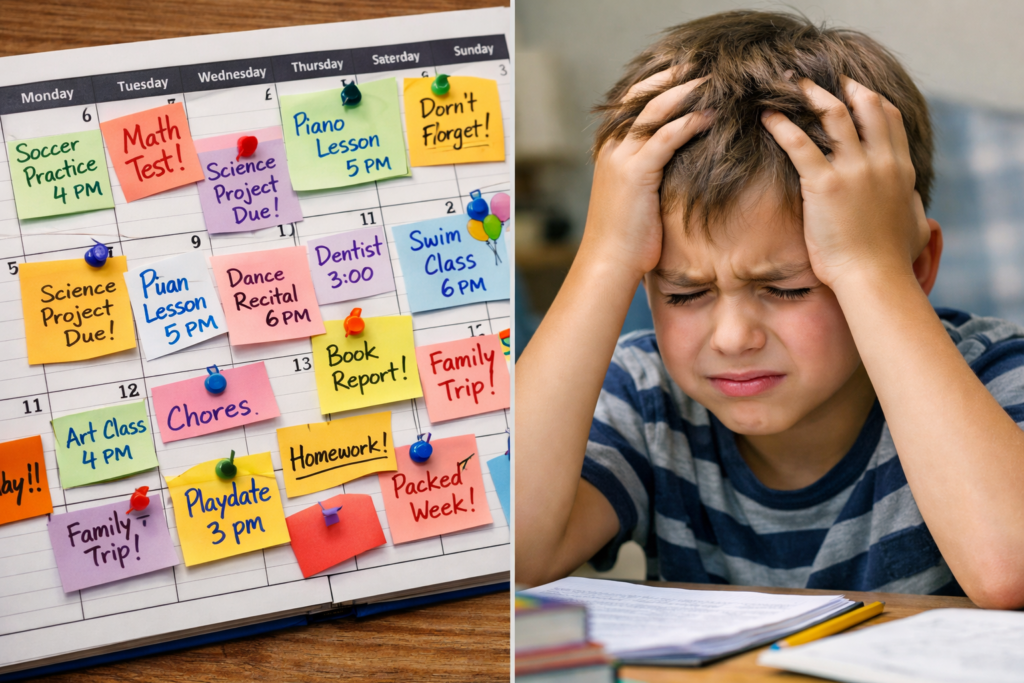
busy child schedule filled with activities causing stress
When children are constantly rushed or stimulated:
1. Stress Systems Stay Activated
Even positive activities can activate stress when they’re continuous.
The brain’s survival systems become more active.
Emotional regulation becomes harder.
A stressed brain does not learn optimally; read more on how stress affects child’s brain development here
2. Memory Consolidation Weakens
If evenings are packed and sleep becomes shortened or irregular, memory consolidation suffers.
Skills practiced during the day may not solidify.
Effort increases. Progress slows.
3. Curiosity Shrinks
When every activity is adult-directed, children stop initiating.
They begin performing instead of exploring.
Curiosity — the spark behind talent — needs autonomy.
4. Intrinsic Motivation Declines
If growth feels externally driven, children may:
- Lose internal drive
- Become approval-focused
- Avoid challenges without supervision
True talent development requires internal motivation and space.
Overscheduling can unintentionally replace it with pressure.
The Difference Between Exposure and Overload
Exposure is healthy.
Overload is cumulative.
Exposure looks like:
- Trying activities
- Exploring interests
- Having structured practice with recovery
Overload looks like:
- No unstructured time
- Fatigue
- Irritability
- Resistance to once-loved activities
- Declining sleep quality
The key difference?
Recovery time.
Growth happens in the rhythm between effort and rest.
Why Unstructured Time Matters More Than You Think
Unstructured time allows the brain to:
- Daydream
- Reflect
- Experiment
- Create
- Problem-solve independently
Many creative breakthroughs begin in boredom.
When a child says, “I’m bored,”
their brain is searching.
That search builds imagination and autonomy.
Unstructured time is not wasted time.
It is self-directed development.
Signs Your Child May Be Over-scheduled
Not every busy child is overwhelmed.
But watch for patterns:
- Frequent irritability
- Increased meltdowns
- Trouble sleeping
- Loss of enthusiasm
- Complaints of exhaustion
- Drop in focus
- Anxiety before activities
If multiple signs appear consistently, it may not be a motivation issue.
It may be a load issue.
The Long-Term Risk
Overscheduling can unintentionally teach children:
- Performance over curiosity
- Achievement over reflection
- Approval over autonomy
But long-term excellence — in any field — requires:
- Deep focus
- Emotional regulation
- Intrinsic motivation
- Creative thinking ( in our next article, we will talk about; how you may help you child to be creative)
- Recovery cycles
Without space, those qualities struggle to develop.
A Healthier Model: Rhythm, Not Rush
Instead of asking:
“How much can we fit in?”
Ask:
“What rhythm supports growth?”
Healthy rhythm includes:

child enjoying free play which supports healthy development
- Practice
- Rest
- Reflection
- Free play
- Sleep
- Connection
Growth is not about constant acceleration.
It’s about sustainable development.
What Parents Can Do
Here are practical shifts:
1. Protect At Least One Free Afternoon per Week
No structured activities. Let interest emerge.
2. Watch Energy, Not Just Achievement
Is your child energized or drained?
3. Prioritize Sleep Over Extra Practice
Fatigued practice is low-quality practice.
4. Leave Gaps Between Activities
The brain needs transition time.
5. Periodically Reassess Commitments
Ask:
“Is this still meaningful?”
It’s okay to pause.
It’s okay to reduce.
It’s wise to protect space.
Final Thoughts: Growth Needs Breathing Room
It’s natural to want to give your child every opportunity.
But opportunities only help when the brain has space to grow around them.
More activities do not automatically create more ability.
Sometimes, less activities create deep focus and creativity.
If you want to nurture talent:
Protect sleep.
Protect unstructured time.
Protect emotional balance.
Because children don’t grow from constant motion.
They grow from rhythm.