

Learn how your child’s brain works and why brain integration is essential for emotional regulation, confidence, and nurturing natural talents.
Most parents know their child’s body very well.
You know what foods upset their stomach.
You know what temperature means fever.
You notice when they’re tired just by how they walk.
But when it comes to the brain — the part that shapes emotions, behavior, relationships, decision-making, confidence, and even school performance — many parents feel unsure.
Even highly educated parents.
The brain is not just another organ.
It is the control center of your child’s personality, reactions, focus, creativity, and resilience.
Understanding how your child’s brain works won’t remove every parenting challenge.
But it will change how you respond.
It will help you:
- Interpret behavior more accurately
- Reduce unnecessary frustration
- Respond instead of react
- Strengthen your relationship
- And most importantly — create the right conditions for your child’s talents to grow
If we want to nurture potential, we must first understand the soil it grows in.
That soil is the brain.
Understanding the Different Parts of the Brain
Our brain has different parts, and each part has a different role.
When parents understand this, behavior starts to make more sense.
The Left and Right Hemispheres
The brain has two sides that process information differently.
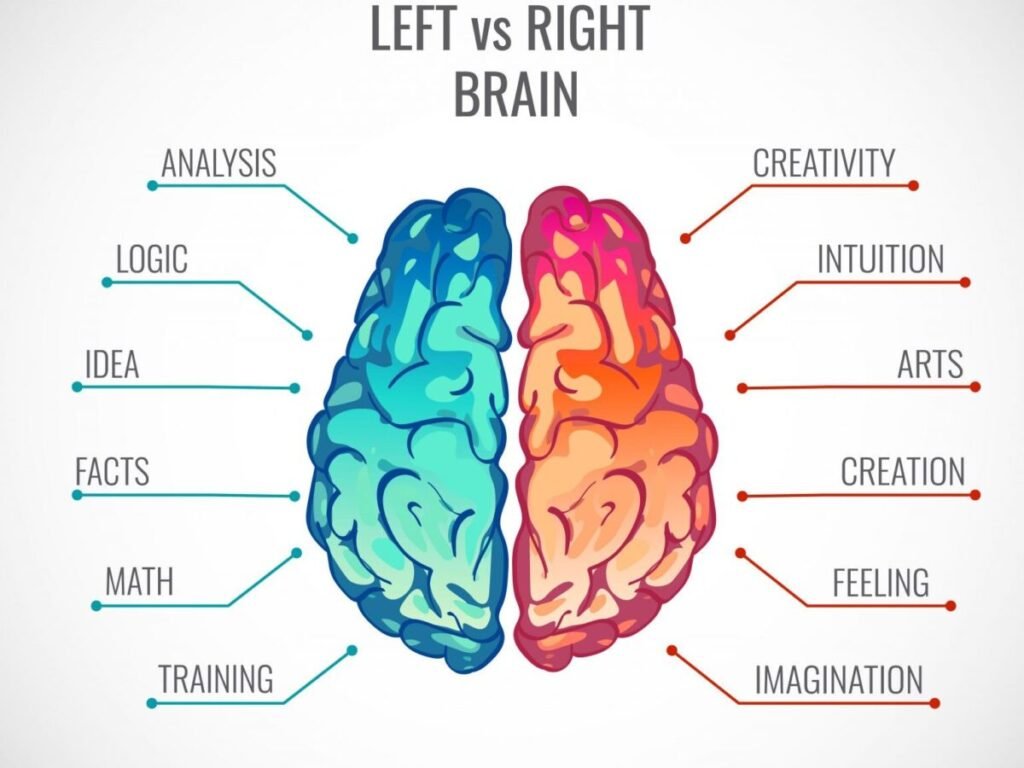
Brain hemispheres (left and right)
The Left Hemisphere
The left side helps with:
- Logical thinking
- Organizing thoughts into sentences
- Language and words
- Sequences and order
- Cause-and-effect reasoning
It prefers structure.
It likes clarity.
It wants things to “make sense.”
The Right Hemisphere
The right side is different.
It processes:
- Emotions
- Nonverbal communication
- Facial expressions
- Tone of voice
- Body language
- Images and big-picture meaning
It doesn’t think in sentences.
It thinks in feelings and images.
For example:
If your child says, “Nobody likes me,”
that statement is coming more from the emotional right brain than the logical left brain.
Responding with logic (“That’s not true, you have friends.”) may not help immediately.
Responding with connection (“That must have felt lonely.”) speaks to the right brain first.
The Reptile Brain (Survival Brain)
The reptile brain (often associated with the brainstem) is responsible for survival.
It controls:
- Fight
- Flight
- Freeze
- Basic instincts
- Automatic reactions
This part acts fast.
It does not reason.
It reacts.
When a child suddenly hits, screams, runs away, or shuts down — this survival system may be activated.
In that moment, your child is not “being difficult.”
Their brain is trying to protect them.
The Mammal Brain (Emotional & Relationship Brain)
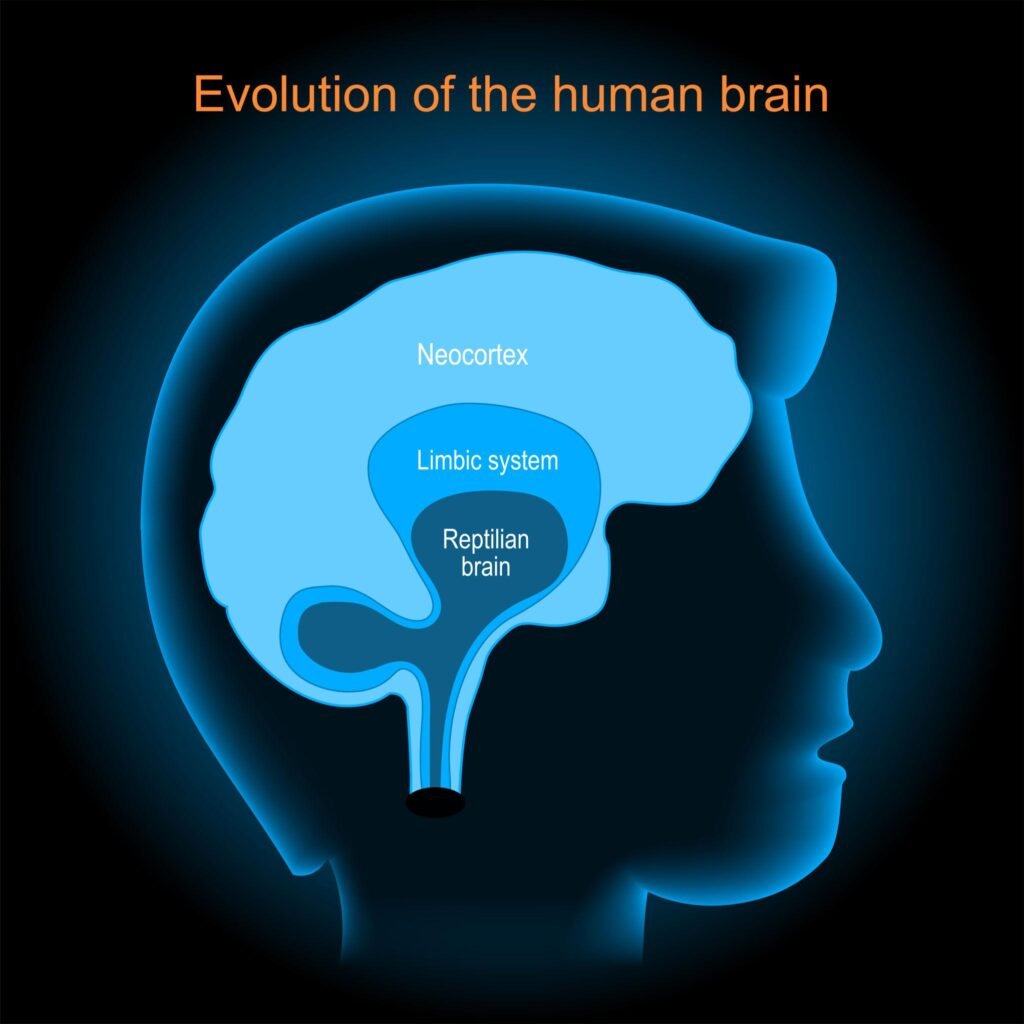
Limbic system brain referred as mammal brain
The mammal brain (often linked to the limbic system) is responsible for:
- Attachment
- Emotional bonding
- Social connection
- Memory tied to feelings
This is the part that makes your child seek comfort after falling.
It drives connections.
Children are wired for relationships before they are wired for logic.
Connection calms the brain.
Disconnection activates stress.
What Is Brain Integration?
The brain has different parts with different “personalities.”
Integration is when these parts work together.
It simply means linking the logical brain, emotional brain, and survival brain so they function as a coordinated whole.
Think about the body:
The stomach processes food.
The heart pumps blood.
The lungs oxygenate it.
Blood vessels circulate it.
Different roles.
One system.
That is integration.
When the emotional brain and logical brain communicate well, a child can say:
“I’m angry… but I won’t hit.”
That is integration.
Why Brain Integration Matters
Mental health is not about being calm all the time.
It is about flexibility.
When the brain is integrated, a child can:
- Handle frustration without falling apart
- Shift from disappointment to problem-solving
- Express feelings with words
- Recover faster after mistakes
- Build stable relationships
- Stay curious instead of shutting down
- Learn effectively
Mental well-being is often described as the ability to cope with stress, learn, work, and contribute to life.
All of that depends on how well different parts of the brain communicate.
Integration supports:
- Emotional regulation
- Resilience
- Focus
- Social intelligence
- Confidence
- And long-term talent development
- Talents grow best in a regulated brain.
When a Child’s Brain Isn’t Integrated
When integration is weak or overwhelmed:
- Emotions feel too big
- Reactions are extreme
- Thinking becomes rigid (“It must be my way!”)
- Or chaotic (crying, yelling, collapsing)
- Problem-solving shuts down
- Social relationships suffer
A child may:
- Have frequent meltdowns
- Become aggressive or withdrawn
- Struggle to adapt to small changes
- React impulsively
- Avoid challenges
This doesn’t mean something is “wrong” with the child.
It means the brain needs support in linking its parts.
The River of Well-Being
Think your children’s life as river; the river that has two bank sides, one bank has rigid and the other bank is chaotic. Many of the challenges you face as parents result from the time when your kids aren’t in the flow, when they are either too chaotic or too rigid while you want them to remain in the flow of the river.
Your three-year-old boy won’t share a toy in the park? That is ‘’Rigidity’’. He erupts into crying and yelling, throwing away everything when his friend takes the toy, that is ‘’chaos’’. What you will do is to help and guide your child back into the flow of the river, into a harmonious state that avoids both chaos and rigidity.
A child’s emotional life is like a river. One bank is rigid. The other bank is in chaos.
Rigidity looks like:
- Refusing to share
- Insisting on sameness
- Melting down over small changes
Chaos looks like:
- Explosive crying
- Physical aggression
- Total overwhelm
The goal is flow.
Flow means flexibility.
Your job as a parent isn’t to eliminate emotion.
It’s to guide your child back into the middle of the river.
How Parents Can Support Brain Integration
Here are practical ways caregivers can help:
1. Connect Before Correct
When a child is upset, calm the connection first.
Kneel,
Lower your voice.
Acknowledge the feeling.
Connection activates the emotional brain in a safe way.
2. Name the Emotion
“You’re really frustrated.”
Labeling feelings helps the logical brain engage; do that by showing empathy and feeling.
When children can name it, they can manage it.
3. Tell the Story Later
After a meltdown, revisit the event calmly.
“What happened at the park?”
This links emotion with logic — strengthening integration.
4. Encourage Problem-Solving
“What could we try next time?”
This activates the planning centers of the brain.
5. Model Regulation
Your nervous system influences theirs.
A calm adult brain supports a calmer child’s brain.
6. Allow Safe Challenges
Growth happens in manageable stretches.
Not too easy.
Not overwhelming.
That balance strengthens integration over time.
Why This Matters for Talent Development
A child cannot develop their talents consistently if their brain is constantly overwhelmed.
Integration supports:
- Deep focus
- Creative thinking
- Persistence
- Emotional resilience
- Healthy risk-taking
Talent is not just ability.
It is ability + regulation + confidence.
When the brain is integrated, curiosity grows.
When curiosity grows, skills follow.
Final Thoughts
Understanding your child’s brain is not about becoming a neuroscientist.
It’s about becoming more observant.
When you understand why your child reacts the way they do, you respond differently.
And when you respond differently, the brain changes.
Integration builds emotional strength.
Emotional strength protects curiosity.
Curiosity fuels talent.
If you want to nurture your child’s gifts,
start by helping their brain work as a team.
Everything else grows from there.