
Learn why sleep is essential for talent development in children. Discover how memory consolidation, emotional regulation, and brain integration during sleep strengthen learning and skill growth.
In a culture that praises productivity, sleep often looks unproductive.
Some adults feel guilty spending “too much” time in bed.
And sometimes, children who sleep longer are labeled lazy.
But neuroscience tells a very different story.
Sleep is not the opposite of productivity.
It is the hidden partner of growth.
When your child is asleep, their brain is not inactive.
It is working intensely — organizing, strengthening, and integrating everything learned during the day.
If your child is learning piano, language, mathematics, sports, or any new skill — sleep is not optional.
It is part of the training.
What Happens in the Brain During Sleep?
During the day, your child’s brain absorbs new experiences.
But those new memories are fragile.
Neuroscience shows that newly acquired memories are initially unstable. They require a process called memory consolidation to become strong, durable, and accessible later.
This consolidation happens largely during sleep.
When your child sleeps:
- Neural circuits activated during learning are reactivated.
- Connections between neurons are strengthened.
- Important information is protected.
- Irrelevant information is filtered out.
Without sleep, the brain cannot properly stabilize what was learned.
And if consolidation doesn’t happen, skills do not solidify.
Sleep is where practice becomes progress.
Why Sleep Matters During Skill and Talent Development

Whether your child is:
- Learning guitar
- Practicing basketball
- Studying a new language
- Developing drawing skills
- Memorizing academic material
Sleep determines how well that learning sticks.
Research shows that even disrupted sleep two or three days after learning something new can weaken long-term memory of that experience.
That means:
Practice without sleep is incomplete.
If your child stays up late after intense learning, their brain may not fully secure what they worked hard to build.
Talent grows through repetition — but repetition only works when the brain has time to consolidate.
And that time is sleep.
The Three Types of Brain Processing That Happen During Sleep
Sleep researchers such as Matthew Walker (UC Berkeley) and Robert Stickgold (Harvard Medical School) describe three powerful forms of information processing during sleep:
1. Unitization: Building the Whole
Unitization combines small pieces of learning into a unified skill.
For example:
A child learning a piano piece practices small sections during the day.
During sleep, the brain binds those pieces together into a smoother performance.
The next morning, the piece often feels more fluid — even without additional practice.
That is not magic.
It is neural integration.
2. Assimilation: Connecting to What Is Already Known
Assimilation integrates new information into existing knowledge networks.
If your child learns new vocabulary, the brain doesn’t just store the words.
During sleep, it links them to previous words, concepts, and experiences.
This is why learning becomes deeper over time.
Sleep helps the brain build meaning — not just memory.
3. Abstraction: Discovering Hidden Patterns
Abstraction is one of the most powerful processes.
During sleep, the brain extracts patterns and rules from experiences.
It simplifies complexity.
This may explain why:
- Children suddenly “get” a math concept the next day.
- A problem that felt impossible at night feels clearer in the morning.
- Young children, who sleep more, absorb language so quickly.
Sleep enhances pattern recognition — and pattern recognition is foundational for talent.
The Consequences of Sleep Deprivation
When sleep is insufficient, several systems are affected.
Cognitive Effects
- Weak memory consolidation
- Slower learning
- Reduced focus
- Poor problem-solving
Emotional Effects
- Irritability
- Anxiety
- Impulse control difficulties
- Emotional instability
Physical Effects
- Weakened immune system
- Increased risk of obesity
- Higher long-term risk for chronic health conditions
But from a talent-development perspective, one consequence stands out:
Lost sleep means weakened learning.
And weakened learning means slowed skill growth.
Recommended Sleep Duration by Age
While individual needs vary, general guidelines suggest:
- Newborns (0–2 months): 14–17 hours
- Infants (3–11 months): 12–15 hours
- Toddlers (1–2 years): 11–14 hours
- Preschoolers (3–5 years): 10–13 hours
- School-age children (6–13 years): 9–11 hours
- Teenagers (14–17 years): 8–10 hours
Sleep needs often increase during periods of intense learning or growth.
If your child is developing a new skill, preparing for exams, or practicing regularly, protecting sleep becomes even more important.
The Parent’s Role: Protect the Invisible Work

parent’s stories before bed time help child to sleep well
Parents often protect:
- Practice schedules
- School performance
- Extra lessons
- Structured activities
But sleep is rarely defended with the same seriousness.
Here is what you can do:
1. Protect Consistent Bedtimes
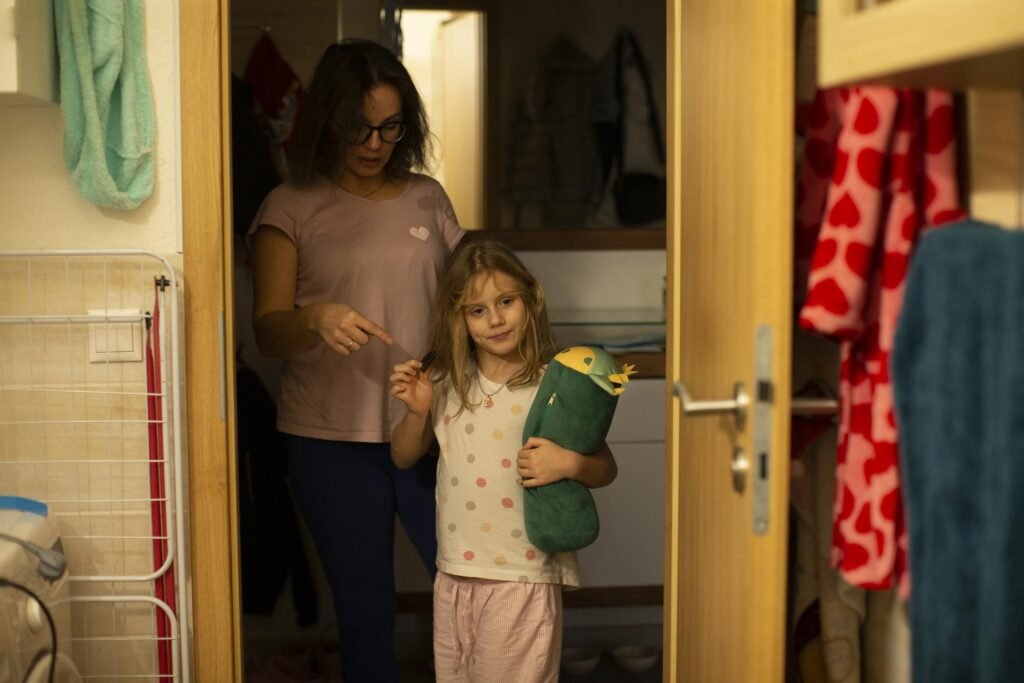
regular sleep time routine help child’s learning development
Regular sleep schedules strengthen brain rhythms.
2. Avoid Overscheduling Evenings
Too many late activities interfere with consolidation.
3. Reduce Screens Before Bed
Light exposure can delay sleep and disrupt deep stages.
4. Reframe Sleep as Growth
Speak about sleep positively:
“Your brain is building strength while you rest.”
When children understand sleep as part of training, they respect it more.
Final Thoughts: Sleep Is Part of the Practice
If your child is working hard to develop a talent, remember this:
Practice shapes the brain.
Sleep strengthens it.
Talent does not grow from effort alone.
It grows from effort + recovery + integration.
When we protect sleep, we are not slowing development.
We are allowing the brain to do its deepest work.
If you truly want to nurture your child’s potential,
treat sleep as essential — not optional.
Because while your child rests,
their brain is building tomorrow’s ability.